
1
Drilling and Injecting
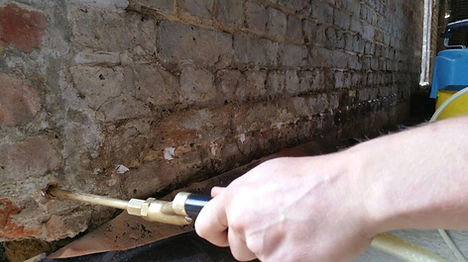
When we install our chemical damp proof course, holes are drilled into the mortar of the bricks at a specified height.
Most commonly, the damp proof course is injected to the second mortar joint up from the internal floor height. This height can differ depending on the external ground levels. For example, if the levels are higher than the internal floor level the the injection would need to be at least 115mm above the external ground levels and a membrane system applied to the lower internal brickwork.
This work is carried out internally. External drilling can be carried out, however, this will not reduce or rectify any dampness which has contaminated the wall plaster internally.
Re-plastering is often required after the insertion of a damp-proof course. New wall plaster will then prevent the migration of damp and salts from the wall to the internal wall decoration.
2
Electro Osmotic Damp Proofing
An Electro Osmotic damp proofing system is a chemical-free system that utilises the principle of Electro-Osmosis. This occurs when an electric potential is applied across a damp porous material which caused a force to be exerted on the water, which then moved towards the cathode (earth). The system involves inserting platinum coated titanium wire anodes into the wall at regular intervals.
These anodes (which are joined together by plain titanium wire) are places around the building in a ring main type configuration. One end if then connected to a low voltage power supply and the circle is completed at the other end by an earthing rod (cathode) driven into the ground to a level below that of the anodes, and at a distance of at least 2 meters away from the nearest anode. The operational system then provides the electric potential which stops the rising damp, allowing the wall to dry out.
The system includes the anodes, which are supplied spliced into rolls of pure titanium wire, connecting wire, connecting crimps, power units, earthing rods, sleeving, and crimping tool.
Installation of the anodes can be from the outside of inside of the building, in either case the internal rendering will almost certainly need to be removed due to the salt contamination. The anodes re inserted into the wall via holes drilled from a mortar bed down to a 10–30-degree angle. The wire between each anode is places into a 20mm chase or groove which has been cut into the mortar bed. Doorways and other openings can be bridges using plan titanium wire. Following installation, the anodes holes are filled, and the groove pointed up.
Rising damp refers to water travelling through porous building materials that are in contact with the ground. This causes the wall to draw water from the ground, which in turn evaporates into the atmosphere. This pattern continues, until the water reaches a height where it can no longer evaporate, meaning dampness will occur and remain in the wall.
Most buildings are built with a damp proofing course already installed. However, it is possible that some types can break down and will need replacing.
It also can be that structural changes to a property mean that a different type of damp proof course may be needed.
A water-based silicone injection is considered the most effective damp proof course at preventing the rise of moisture through walls.
Damp Proofing

